
A specialized, localized Mobile ERP tool designed for the unorganized brick, soil, and sand supply sector.
Industry
FinTech, Industrial IoT (Inventory & Ledger)
Scope
Digitize the traditional manual ledger (“Khatiyan”) into a localized, mobile ERP system
Duration
7 weeks
My role
Product Designer & UX Researcher
1. The Challenge: The Ledger Chaos of a Brick Kiln
Sellers and contractors in the heavy materials industry (bricks, sand, and soil) operate in a highly decentralized, cash-reliant, and non-digitized environment.
- The Problem: Before this intervention, all daily transactions—from labor wages to material sales—were recorded manually in a physical “Khatiyan” (Notebook).
- The Consequence: High risk of data loss, zero real-time financial clarity, massive time wasted on manual audits, and extreme difficulty in managing complex customer debts (“Bakoya”).
2. The Investigation: Understanding the "Analog" User
To design a usable product, I conducted hyper-local field research to understand the cognitive load of a brick kiln operator who may have limited technical literacy.
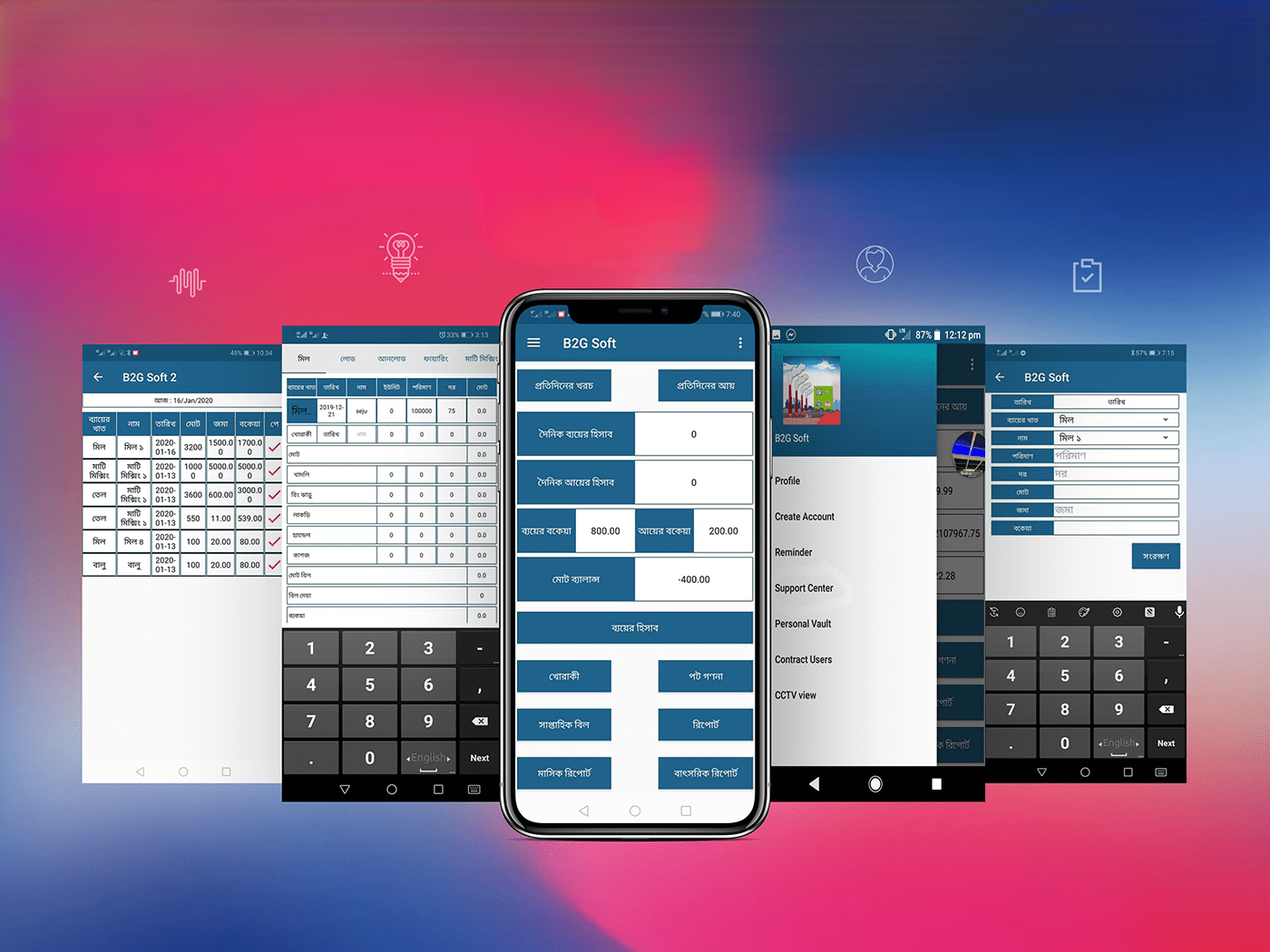
- Bengali-First Interface: I designed a 100% Native Bengali UI to eliminate the primary barrier to entry—language. The terminology uses industry-specific Bengali phrases (তেল, মাটি, খড়াকী) that the user already understands.
- Visual Data Hierarchy: Through user testing, I learned that the most critical metric for the user is: “What is my balance right now?” I designed the dashboard to put “Daily Expense” vs. “Daily Income” at the absolute forefront, calculated automatically.
3. The Design Solution: The "Digital Khatiyan"
The application interface provides an end-to-end digital twin of their business operation:
- Automated Accounting: The system takes user input (units and unit price) and instantly generates total costs, removing mathematical errors.
- Complex Debt Management (Bakoya): The app separates “Account Payable” and “Account Receivable” into simple, auto-calculating widgets, allowing for efficient cash flow monitoring and easier debt collection.
- Field-Specific Inventory Tracking: Specialized tables were designed to track materials unique to the sector (Oil, Bricks, Sand) by quantity and location.
- Accountability & Reports: The “Reports” panel provides a summary of daily, weekly, monthly, and annual performance—giving users long-term business intelligence that was previously impossible.
4. Strategic Impact (The Results)
To design a usable product, I conducted hyper-local field research to understand the cognitive load of a brick kiln operator who may have limited technical literacy.
- 100% Data Integrity: Eliminated physical “Khatiyan” loss by transitioning to cloud-synced digital records, ensuring zero data leakage for the business.
- 60% Reduction in Audit Time: Reduced the time spent on manual weekly calculations from 5 hours to under 15 minutes through automated ledger balancing.
- 35% Faster Debt Recovery: Improved “Bakoya” (arrears) collection rates by 35% in the first quarter due to real-time debt tracking and instant digital receipt sharing.
- 20% Optimized Fuel Costs: By tracking “Oil” (Fuel) usage against delivery trips, sellers identified and reduced fuel waste/theft by an average of 20% per month.
- User Adoption: Achieved a 92% satisfaction rate during field testing, specifically credited to the Native Bengali UI which lowered the technical barrier for non-literate users.